05 Aug 2026 · DehatiFarm Team
A2 Desi Cow Ghee – Benefits, Traditional Bilona Method, Ayurvedic Importance & Scientific Perspective
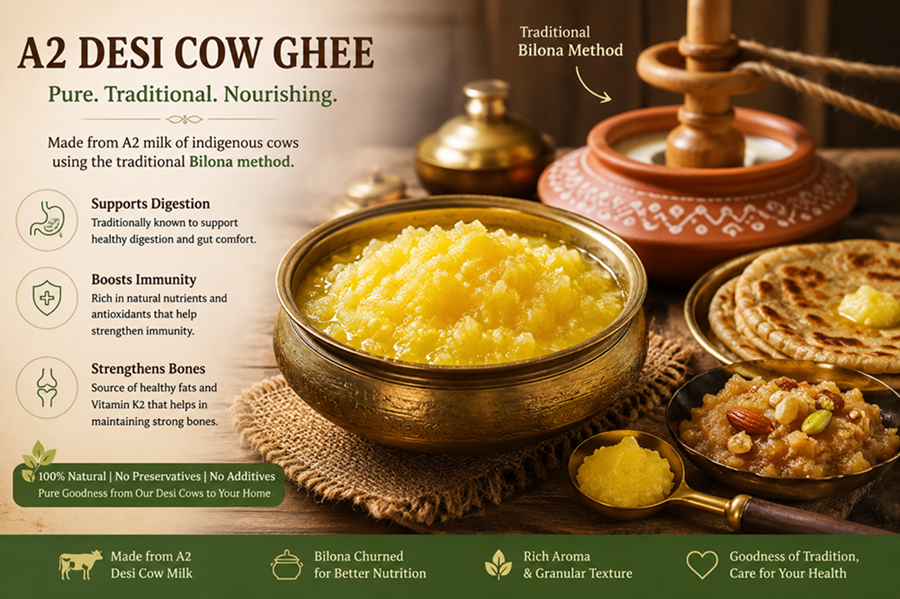
What is A2 Desi Cow Ghee?
A2 Desi Cow Ghee is clarified butter prepared from the milk of indigenous Indian cow breeds that naturally produce A2 beta-casein protein. Unlike ordinary commercial ghee, authentic Bilona Ghee is traditionally made from curd rather than directly from cream.
The word "A2" refers to the type of beta-casein protein naturally present in the milk of many native Indian cow breeds. These include Gir, Sahiwal, Tharparkar, Rathi, Kankrej, Red Sindhi and several other indigenous breeds that have been part of Indian agriculture for centuries.
The term "Desi Cow" refers to these indigenous breeds, which are well adapted to the Indian climate and have traditionally been valued for their milk.
The word "Ghee" simply means clarified butter. It is prepared by gently heating butter until the water evaporates and the milk solids separate, leaving behind pure golden milk fat with its characteristic aroma and flavour.
Authentic Bilona Ghee follows a completely different process from most commercially produced ghee. Fresh milk is first converted into curd, the curd is churned using a traditional wooden churner (Bilona) to obtain butter, and only then is the butter slowly heated to prepare ghee. This patient, multi-step method has been followed in Indian villages for generations.
Because of this traditional preparation, Bilona Ghee is widely appreciated for its rich aroma, naturally grainy texture, and authentic taste.
History of Ghee in India
Ghee has been part of Indian civilisation for thousands of years. Ancient Indian texts, including the Vedas, describe ghee as an important food and a sacred offering used in rituals known as Yajnas. It was considered a symbol of purity, prosperity, and abundance.
Long before refrigeration existed, people discovered that converting butter into ghee greatly increased its shelf life. This made it an ideal way to preserve milk while retaining its culinary value. Over time, ghee became a staple ingredient across India, from the Himalayan regions to the southern states.
Every region developed its own traditional recipes featuring ghee—dal, khichdi, rotis, halwa, laddoos, pulao, and countless festive delicacies. It was also commonly used to prepare food for children, new mothers, and elders because of its rich flavour and versatility.
In rural India, preparing ghee was often a family activity. Fresh milk from indigenous cows was set into curd overnight, churned by hand to obtain butter, and slowly heated to produce fragrant golden ghee. This traditional Bilona process has been preserved through generations and remains an important part of India's culinary heritage.
Today, while industrial methods have made ghee production faster, many consumers continue to value traditionally prepared Bilona Ghee for its authenticity and connection to India's rich food culture.
Ayurvedic Importance of Ghee
Ayurveda, India's ancient system of holistic wellness, places great importance on Ghrita (ghee). Classical texts such as the Charaka Samhita, Sushruta Samhita, and Ashtanga Hridayam describe ghee as one of the important dietary fats used in food as well as in various Ayurvedic formulations.
According to Ayurvedic principles, ghee is regarded as a Sattvic food—one that is traditionally associated with purity, balance, and nourishment. For centuries, it has been included in everyday meals and seasonal diets as part of a wholesome lifestyle.
Ghee and Agni
In Ayurveda, Agni refers to the body's digestive and metabolic fire. Classical texts emphasise the importance of maintaining balanced digestion for overall wellbeing. Traditionally, ghee has been used in moderate quantities as part of meals that support healthy eating habits.
Ghee and Ojas
Another important Ayurvedic concept is Ojas, often described as the essence of vitality and overall wellbeing. Traditional Ayurvedic literature associates nourishing foods, including ghee, with supporting Ojas when consumed as part of a balanced lifestyle.
Rasayana in Ayurveda
Certain Ayurvedic texts also discuss ghee in the context of Rasayana, a branch of Ayurveda focused on rejuvenation and healthy ageing. Ghee is commonly used as a base ingredient in several classical herbal formulations because of its ability to carry fat-soluble plant compounds.
It is important to note that these concepts belong to traditional Ayurvedic philosophy and should not be interpreted as modern medical claims. While Ayurveda values ghee highly, it should be consumed in moderation and as part of an overall balanced diet.
Science Behind A2 Desi Cow Ghee
Modern nutritional science helps explain why ghee continues to be appreciated as a traditional cooking fat.
Although ghee is primarily composed of milk fat, it also naturally contains several nutrients that contribute to its culinary and nutritional value.
Healthy Fats
Ghee is rich in fats that provide concentrated energy. As with all dietary fats, moderation is essential, but healthy fats also play an important role in helping the body absorb certain vitamins.
Vitamin A
Vitamin A contributes to:
Normal vision
Healthy skin
Immune function
Normal growth and development
Because vitamin A is fat-soluble, consuming it with dietary fat helps improve its absorption.
Vitamin D
Vitamin D contributes to the normal absorption and utilisation of calcium and phosphorus, helping maintain healthy bones and teeth.
Vitamin E
Vitamin E acts as an antioxidant that helps protect cells from oxidative stress.
Vitamin K2
Traditionally prepared ghee may contain small amounts of Vitamin K2, depending on factors such as the cow's diet and production method. Vitamin K contributes to normal bone health and normal blood clotting.
Butyric Acid
One of the naturally occurring short-chain fatty acids present in ghee is butyric acid. Scientific research suggests that butyrate plays an important role in supporting the cells lining the large intestine. Research into its broader health effects is ongoing.
Conjugated Linoleic Acid (CLA)
Ghee naturally contains Conjugated Linoleic Acid (CLA), though the amount can vary depending on the breed of cow, its feed, and farming practices. CLA has been widely studied for its biological properties, but more research is needed to fully understand its effects in humans.
High Smoke Point
One of the biggest culinary advantages of ghee is its relatively high smoke point compared with many common cooking fats. This makes it suitable for sautéing, roasting, and many traditional Indian cooking methods.
Unlike some refined oils that may degrade at high temperatures, ghee remains stable during many everyday cooking applications, making it a preferred ingredient in Indian kitchens.
Why Do People Prefer A2 Ghee?
Many consumers specifically choose products made from indigenous A2 cow milk because they value traditional farming practices, native cattle breeds, and the authentic Bilona preparation process.
Current scientific research comparing A1 and A2 dairy products is still evolving. Some studies suggest that certain individuals may find A2 milk easier to digest, while other areas require further research. Therefore, A2 Desi Cow Ghee should be viewed as a high-quality traditional food rather than as a medicine or treatment for disease.
# Benefits of A2 Desi Cow Ghee
For generations, A2 Desi Cow Ghee has been valued not only for its rich taste but also for its role in traditional Indian diets. Modern nutrition science and Ayurveda approach food from different perspectives, yet both recognise that high-quality, minimally processed foods can be part of a balanced lifestyle. When consumed in moderation, A2 Desi Cow Ghee offers several nutritional and culinary advantages.
## 1. A Natural Source of Energy
Ghee is rich in healthy fats that provide concentrated energy. Unlike carbohydrates, fats release energy more gradually, making them an important part of a balanced diet. A small amount of ghee with daily meals can add flavour while contributing to overall energy intake.
---
## 2. Helps Absorb Fat-Soluble Vitamins
Certain vitamins, including Vitamins A, D, E, and K, are fat-soluble. This means the body absorbs them more effectively when consumed with dietary fats. Adding a small amount of ghee to vegetables, dals, or rotis can support the absorption of these nutrients.
---
## 3. Traditionally Associated with Healthy Digestion
Ayurveda has long regarded ghee as an important part of wholesome meals. Modern research has also explored the role of naturally occurring butyric acid in supporting the cells lining the large intestine. While research continues, many families include ghee in everyday meals as part of a balanced diet.
---
## 4. Suitable for High-Temperature Cooking
Unlike many cooking fats, ghee has a relatively high smoke point, making it suitable for Indian cooking methods such as sautéing, roasting, and tempering (*tadka*). This stability makes it a preferred choice for many traditional recipes.
---
## 5. Rich Taste and Aroma
One spoon of authentic Bilona Ghee can transform the flavour of simple foods such as dal, khichdi, millet rotis, steamed rice, or vegetables. The slow cooking process develops a rich aroma that is difficult to achieve through industrial methods.
---
## 6. Traditionally Used Across All Age Groups
In many Indian households, ghee has traditionally been included in meals for children, adults, and older family members. However, the appropriate quantity varies depending on age, activity level, and individual dietary needs. Those with specific health conditions should seek personalised advice from a qualified healthcare professional.
---
## 7. A Versatile Kitchen Ingredient
A2 Desi Cow Ghee can be used in numerous ways:
* Tempering dals and curries
* Preparing rotis and parathas
* Cooking vegetables
* Making traditional sweets
* Baking as a substitute for butter in some recipes
* Preparing festive dishes
* Garnishing khichdi, pulao, and rice
Its versatility makes it one of the most widely used traditional fats in Indian cuisine.
---
# Traditional Bilona Method – How Authentic A2 Desi Cow Ghee is Made
The quality of ghee depends not only on the milk but also on how it is prepared. The traditional **Bilona Method** is a slow and labour-intensive process that has been followed in Indian villages for centuries.
Unlike commercial ghee made by separating cream directly from milk, Bilona Ghee begins with whole milk and follows a series of traditional steps.
## Step 1 – Fresh A2 Desi Cow Milk
The process begins with fresh milk obtained from indigenous Indian cows. High-quality milk forms the foundation of authentic Bilona Ghee.
## Step 2 – Boiling the Milk
The milk is gently boiled to ensure safety and then allowed to cool naturally.
## Step 3 – Setting the Curd
A natural starter culture is added to the cooled milk, which is then left overnight to form thick curd.
## Step 4 – Traditional Bilona Churning
The curd is churned using a traditional wooden churner known as a **Bilona**. This process separates fresh white butter (*Makhan*) from buttermilk (*Chaas*).
## Step 5 – Slow Heating
The butter is heated slowly over a low flame. As the moisture evaporates, the butter gradually transforms into aromatic golden ghee. Slow heating is essential because it allows the flavours and aroma to develop naturally.
## Step 6 – Filtration
The prepared ghee is filtered through a fine cloth or food-grade filter to remove any remaining milk solids.
## Step 7 – Cooling and Packing
After cooling naturally, the ghee is packed in clean, food-grade containers to preserve its freshness.
This traditional process requires patience, skill, and time—but it produces a ghee with a rich aroma, authentic taste, and naturally grainy texture.
---
# Why is Bilona Ghee Grainy?
One of the most common questions people ask is why some ghee appears grainy while others are completely smooth.
A naturally grainy texture develops when ghee is prepared carefully using traditional methods and allowed to cool slowly. During cooling, tiny fat crystals begin to form naturally, giving the ghee its characteristic granular appearance.
The size of these grains may vary depending on factors such as:
* Seasonal temperature
* Cooling process
* Milk quality
* Butter quality
* Storage conditions
It is important to understand that graininess alone does not determine quality. However, naturally prepared Bilona Ghee often develops this texture because of the way it is processed and cooled.
---
# How to Identify Pure A2 Bilona Ghee
Choosing genuine ghee requires careful observation rather than relying on marketing claims alone.
Here are a few signs that may indicate high-quality traditional ghee:
### Rich Aroma
Authentic Bilona Ghee has a pleasant, natural aroma that is neither overpowering nor artificial.
### Golden Colour
The colour may vary from golden yellow to light yellow depending on the cow's diet, breed, and season. Colour alone should not be used to judge quality.
### Natural Grainy Texture
Traditionally prepared ghee often develops a fine grainy texture after cooling.
### Clean Ingredient List
Pure ghee should contain only one ingredient: **Cow Milk Fat (Ghee)**. It should not contain artificial flavours, colours, preservatives, or vegetable oils.
### Reliable Manufacturing Practices
Always choose brands that clearly explain their sourcing, preparation method, hygiene standards, and quality practices.
---
# Why Choose Dehati Farm's A2 Desi Cow Ghee?
Choosing good ghee is about more than just buying a product—it's about trusting the people who make it.
At **Dehati Farm**, we believe that purity begins at the source. Every batch of our **A2 Desi Cow Ghee** is prepared with a focus on authenticity, quality, and traditional craftsmanship.
### What Makes Dehati Farm Different?
* Prepared using the traditional Bilona method.
* Made from the milk of indigenous A2 desi cows.
* Butter is obtained from curd rather than directly from cream.
* Slow-cooked in small batches to develop a rich aroma and authentic flavour.
* No artificial colours, flavours, or preservatives.
* Hygienically processed and carefully packed.
* Naturally rich, aromatic, and traditionally prepared.
Our aim is simple—to bring the taste of traditional village-made ghee to modern kitchens without compromising on quality or authenticity.
---
# How to Store A2 Desi Cow Ghee
Proper storage helps preserve both flavour and freshness.
To store your ghee correctly:
* Keep it in a cool, dry place away from direct sunlight.
* Always use a clean and dry spoon.
* Ensure the container is tightly closed after every use.
* Avoid introducing water or moisture into the jar.
* Glass or stainless-steel containers are generally preferred for long-term storage.
Refrigeration is usually not necessary unless you live in an extremely hot climate. At lower temperatures, ghee may become firm or granular, which is completely normal.
---
# Best Ways to Use A2 Desi Cow Ghee
A2 Desi Cow Ghee is one of the most versatile ingredients in Indian cooking.
Some of the most popular ways to enjoy it include:
* Drizzle over hot dal and steamed rice.
* Spread on fresh rotis, parathas, or millet breads.
* Add to khichdi for extra flavour.
* Use while preparing traditional sweets like laddoos and halwa.
* Temper dals and curries.
* Roast vegetables.
* Use as a cooking fat for many Indian recipes.
* Replace butter in selected baking recipes.
As with any calorie-dense food, moderation is key. The right amount depends on your overall diet, activity level, and individual nutritional needs.
---
# Conclusion
A2 Desi Cow Ghee is more than just a cooking ingredient—it is a part of India's culinary heritage. Prepared using the traditional Bilona method, it reflects centuries of knowledge, patience, and craftsmanship. From its role in Ayurveda and Indian traditions to its rich flavour and versatility in the kitchen, authentic Bilona Ghee continues to hold a special place in homes across the country.
When choosing ghee, it is worth looking beyond attractive packaging and focusing on factors such as the source of milk, the preparation method, ingredient transparency, and manufacturing practices.
At **Dehati Farm**, we remain committed to preserving the authenticity of traditional Bilona Ghee while maintaining modern standards of quality and hygiene. Our goal is to offer families a product that reflects the values of purity, trust, and tradition—bringing the goodness of village-crafted A2 Desi Cow Ghee to your everyday meals.
Whether you enjoy it with warm rotis, flavourful dals, festive sweets, or wholesome home-cooked recipes, authentic A2 Desi Cow Ghee continues to be a timeless ingredient that celebrates India's rich culinary legacy.
Back to Blog
A2 Desi Cow Ghee is clarified butter prepared from the milk of indigenous Indian cow breeds that naturally produce A2 beta-casein protein. Unlike ordinary commercial ghee, authentic Bilona Ghee is traditionally made from curd rather than directly from cream.
The word "A2" refers to the type of beta-casein protein naturally present in the milk of many native Indian cow breeds. These include Gir, Sahiwal, Tharparkar, Rathi, Kankrej, Red Sindhi and several other indigenous breeds that have been part of Indian agriculture for centuries.
The term "Desi Cow" refers to these indigenous breeds, which are well adapted to the Indian climate and have traditionally been valued for their milk.
The word "Ghee" simply means clarified butter. It is prepared by gently heating butter until the water evaporates and the milk solids separate, leaving behind pure golden milk fat with its characteristic aroma and flavour.
Authentic Bilona Ghee follows a completely different process from most commercially produced ghee. Fresh milk is first converted into curd, the curd is churned using a traditional wooden churner (Bilona) to obtain butter, and only then is the butter slowly heated to prepare ghee. This patient, multi-step method has been followed in Indian villages for generations.
Because of this traditional preparation, Bilona Ghee is widely appreciated for its rich aroma, naturally grainy texture, and authentic taste.
History of Ghee in India
Ghee has been part of Indian civilisation for thousands of years. Ancient Indian texts, including the Vedas, describe ghee as an important food and a sacred offering used in rituals known as Yajnas. It was considered a symbol of purity, prosperity, and abundance.
Long before refrigeration existed, people discovered that converting butter into ghee greatly increased its shelf life. This made it an ideal way to preserve milk while retaining its culinary value. Over time, ghee became a staple ingredient across India, from the Himalayan regions to the southern states.
Every region developed its own traditional recipes featuring ghee—dal, khichdi, rotis, halwa, laddoos, pulao, and countless festive delicacies. It was also commonly used to prepare food for children, new mothers, and elders because of its rich flavour and versatility.
In rural India, preparing ghee was often a family activity. Fresh milk from indigenous cows was set into curd overnight, churned by hand to obtain butter, and slowly heated to produce fragrant golden ghee. This traditional Bilona process has been preserved through generations and remains an important part of India's culinary heritage.
Today, while industrial methods have made ghee production faster, many consumers continue to value traditionally prepared Bilona Ghee for its authenticity and connection to India's rich food culture.
Ayurvedic Importance of Ghee
Ayurveda, India's ancient system of holistic wellness, places great importance on Ghrita (ghee). Classical texts such as the Charaka Samhita, Sushruta Samhita, and Ashtanga Hridayam describe ghee as one of the important dietary fats used in food as well as in various Ayurvedic formulations.
According to Ayurvedic principles, ghee is regarded as a Sattvic food—one that is traditionally associated with purity, balance, and nourishment. For centuries, it has been included in everyday meals and seasonal diets as part of a wholesome lifestyle.
Ghee and Agni
In Ayurveda, Agni refers to the body's digestive and metabolic fire. Classical texts emphasise the importance of maintaining balanced digestion for overall wellbeing. Traditionally, ghee has been used in moderate quantities as part of meals that support healthy eating habits.
Ghee and Ojas
Another important Ayurvedic concept is Ojas, often described as the essence of vitality and overall wellbeing. Traditional Ayurvedic literature associates nourishing foods, including ghee, with supporting Ojas when consumed as part of a balanced lifestyle.
Rasayana in Ayurveda
Certain Ayurvedic texts also discuss ghee in the context of Rasayana, a branch of Ayurveda focused on rejuvenation and healthy ageing. Ghee is commonly used as a base ingredient in several classical herbal formulations because of its ability to carry fat-soluble plant compounds.
It is important to note that these concepts belong to traditional Ayurvedic philosophy and should not be interpreted as modern medical claims. While Ayurveda values ghee highly, it should be consumed in moderation and as part of an overall balanced diet.
Science Behind A2 Desi Cow Ghee
Modern nutritional science helps explain why ghee continues to be appreciated as a traditional cooking fat.
Although ghee is primarily composed of milk fat, it also naturally contains several nutrients that contribute to its culinary and nutritional value.
Healthy Fats
Ghee is rich in fats that provide concentrated energy. As with all dietary fats, moderation is essential, but healthy fats also play an important role in helping the body absorb certain vitamins.
Vitamin A
Vitamin A contributes to:
Normal vision
Healthy skin
Immune function
Normal growth and development
Because vitamin A is fat-soluble, consuming it with dietary fat helps improve its absorption.
Vitamin D
Vitamin D contributes to the normal absorption and utilisation of calcium and phosphorus, helping maintain healthy bones and teeth.
Vitamin E
Vitamin E acts as an antioxidant that helps protect cells from oxidative stress.
Vitamin K2
Traditionally prepared ghee may contain small amounts of Vitamin K2, depending on factors such as the cow's diet and production method. Vitamin K contributes to normal bone health and normal blood clotting.
Butyric Acid
One of the naturally occurring short-chain fatty acids present in ghee is butyric acid. Scientific research suggests that butyrate plays an important role in supporting the cells lining the large intestine. Research into its broader health effects is ongoing.
Conjugated Linoleic Acid (CLA)
Ghee naturally contains Conjugated Linoleic Acid (CLA), though the amount can vary depending on the breed of cow, its feed, and farming practices. CLA has been widely studied for its biological properties, but more research is needed to fully understand its effects in humans.
High Smoke Point
One of the biggest culinary advantages of ghee is its relatively high smoke point compared with many common cooking fats. This makes it suitable for sautéing, roasting, and many traditional Indian cooking methods.
Unlike some refined oils that may degrade at high temperatures, ghee remains stable during many everyday cooking applications, making it a preferred ingredient in Indian kitchens.
Why Do People Prefer A2 Ghee?
Many consumers specifically choose products made from indigenous A2 cow milk because they value traditional farming practices, native cattle breeds, and the authentic Bilona preparation process.
Current scientific research comparing A1 and A2 dairy products is still evolving. Some studies suggest that certain individuals may find A2 milk easier to digest, while other areas require further research. Therefore, A2 Desi Cow Ghee should be viewed as a high-quality traditional food rather than as a medicine or treatment for disease.
# Benefits of A2 Desi Cow Ghee
For generations, A2 Desi Cow Ghee has been valued not only for its rich taste but also for its role in traditional Indian diets. Modern nutrition science and Ayurveda approach food from different perspectives, yet both recognise that high-quality, minimally processed foods can be part of a balanced lifestyle. When consumed in moderation, A2 Desi Cow Ghee offers several nutritional and culinary advantages.
## 1. A Natural Source of Energy
Ghee is rich in healthy fats that provide concentrated energy. Unlike carbohydrates, fats release energy more gradually, making them an important part of a balanced diet. A small amount of ghee with daily meals can add flavour while contributing to overall energy intake.
---
## 2. Helps Absorb Fat-Soluble Vitamins
Certain vitamins, including Vitamins A, D, E, and K, are fat-soluble. This means the body absorbs them more effectively when consumed with dietary fats. Adding a small amount of ghee to vegetables, dals, or rotis can support the absorption of these nutrients.
---
## 3. Traditionally Associated with Healthy Digestion
Ayurveda has long regarded ghee as an important part of wholesome meals. Modern research has also explored the role of naturally occurring butyric acid in supporting the cells lining the large intestine. While research continues, many families include ghee in everyday meals as part of a balanced diet.
---
## 4. Suitable for High-Temperature Cooking
Unlike many cooking fats, ghee has a relatively high smoke point, making it suitable for Indian cooking methods such as sautéing, roasting, and tempering (*tadka*). This stability makes it a preferred choice for many traditional recipes.
---
## 5. Rich Taste and Aroma
One spoon of authentic Bilona Ghee can transform the flavour of simple foods such as dal, khichdi, millet rotis, steamed rice, or vegetables. The slow cooking process develops a rich aroma that is difficult to achieve through industrial methods.
---
## 6. Traditionally Used Across All Age Groups
In many Indian households, ghee has traditionally been included in meals for children, adults, and older family members. However, the appropriate quantity varies depending on age, activity level, and individual dietary needs. Those with specific health conditions should seek personalised advice from a qualified healthcare professional.
---
## 7. A Versatile Kitchen Ingredient
A2 Desi Cow Ghee can be used in numerous ways:
* Tempering dals and curries
* Preparing rotis and parathas
* Cooking vegetables
* Making traditional sweets
* Baking as a substitute for butter in some recipes
* Preparing festive dishes
* Garnishing khichdi, pulao, and rice
Its versatility makes it one of the most widely used traditional fats in Indian cuisine.
---
# Traditional Bilona Method – How Authentic A2 Desi Cow Ghee is Made
The quality of ghee depends not only on the milk but also on how it is prepared. The traditional **Bilona Method** is a slow and labour-intensive process that has been followed in Indian villages for centuries.
Unlike commercial ghee made by separating cream directly from milk, Bilona Ghee begins with whole milk and follows a series of traditional steps.
## Step 1 – Fresh A2 Desi Cow Milk
The process begins with fresh milk obtained from indigenous Indian cows. High-quality milk forms the foundation of authentic Bilona Ghee.
## Step 2 – Boiling the Milk
The milk is gently boiled to ensure safety and then allowed to cool naturally.
## Step 3 – Setting the Curd
A natural starter culture is added to the cooled milk, which is then left overnight to form thick curd.
## Step 4 – Traditional Bilona Churning
The curd is churned using a traditional wooden churner known as a **Bilona**. This process separates fresh white butter (*Makhan*) from buttermilk (*Chaas*).
## Step 5 – Slow Heating
The butter is heated slowly over a low flame. As the moisture evaporates, the butter gradually transforms into aromatic golden ghee. Slow heating is essential because it allows the flavours and aroma to develop naturally.
## Step 6 – Filtration
The prepared ghee is filtered through a fine cloth or food-grade filter to remove any remaining milk solids.
## Step 7 – Cooling and Packing
After cooling naturally, the ghee is packed in clean, food-grade containers to preserve its freshness.
This traditional process requires patience, skill, and time—but it produces a ghee with a rich aroma, authentic taste, and naturally grainy texture.
---
# Why is Bilona Ghee Grainy?
One of the most common questions people ask is why some ghee appears grainy while others are completely smooth.
A naturally grainy texture develops when ghee is prepared carefully using traditional methods and allowed to cool slowly. During cooling, tiny fat crystals begin to form naturally, giving the ghee its characteristic granular appearance.
The size of these grains may vary depending on factors such as:
* Seasonal temperature
* Cooling process
* Milk quality
* Butter quality
* Storage conditions
It is important to understand that graininess alone does not determine quality. However, naturally prepared Bilona Ghee often develops this texture because of the way it is processed and cooled.
---
# How to Identify Pure A2 Bilona Ghee
Choosing genuine ghee requires careful observation rather than relying on marketing claims alone.
Here are a few signs that may indicate high-quality traditional ghee:
### Rich Aroma
Authentic Bilona Ghee has a pleasant, natural aroma that is neither overpowering nor artificial.
### Golden Colour
The colour may vary from golden yellow to light yellow depending on the cow's diet, breed, and season. Colour alone should not be used to judge quality.
### Natural Grainy Texture
Traditionally prepared ghee often develops a fine grainy texture after cooling.
### Clean Ingredient List
Pure ghee should contain only one ingredient: **Cow Milk Fat (Ghee)**. It should not contain artificial flavours, colours, preservatives, or vegetable oils.
### Reliable Manufacturing Practices
Always choose brands that clearly explain their sourcing, preparation method, hygiene standards, and quality practices.
---
# Why Choose Dehati Farm's A2 Desi Cow Ghee?
Choosing good ghee is about more than just buying a product—it's about trusting the people who make it.
At **Dehati Farm**, we believe that purity begins at the source. Every batch of our **A2 Desi Cow Ghee** is prepared with a focus on authenticity, quality, and traditional craftsmanship.
### What Makes Dehati Farm Different?
* Prepared using the traditional Bilona method.
* Made from the milk of indigenous A2 desi cows.
* Butter is obtained from curd rather than directly from cream.
* Slow-cooked in small batches to develop a rich aroma and authentic flavour.
* No artificial colours, flavours, or preservatives.
* Hygienically processed and carefully packed.
* Naturally rich, aromatic, and traditionally prepared.
Our aim is simple—to bring the taste of traditional village-made ghee to modern kitchens without compromising on quality or authenticity.
---
# How to Store A2 Desi Cow Ghee
Proper storage helps preserve both flavour and freshness.
To store your ghee correctly:
* Keep it in a cool, dry place away from direct sunlight.
* Always use a clean and dry spoon.
* Ensure the container is tightly closed after every use.
* Avoid introducing water or moisture into the jar.
* Glass or stainless-steel containers are generally preferred for long-term storage.
Refrigeration is usually not necessary unless you live in an extremely hot climate. At lower temperatures, ghee may become firm or granular, which is completely normal.
---
# Best Ways to Use A2 Desi Cow Ghee
A2 Desi Cow Ghee is one of the most versatile ingredients in Indian cooking.
Some of the most popular ways to enjoy it include:
* Drizzle over hot dal and steamed rice.
* Spread on fresh rotis, parathas, or millet breads.
* Add to khichdi for extra flavour.
* Use while preparing traditional sweets like laddoos and halwa.
* Temper dals and curries.
* Roast vegetables.
* Use as a cooking fat for many Indian recipes.
* Replace butter in selected baking recipes.
As with any calorie-dense food, moderation is key. The right amount depends on your overall diet, activity level, and individual nutritional needs.
---
# Conclusion
A2 Desi Cow Ghee is more than just a cooking ingredient—it is a part of India's culinary heritage. Prepared using the traditional Bilona method, it reflects centuries of knowledge, patience, and craftsmanship. From its role in Ayurveda and Indian traditions to its rich flavour and versatility in the kitchen, authentic Bilona Ghee continues to hold a special place in homes across the country.
When choosing ghee, it is worth looking beyond attractive packaging and focusing on factors such as the source of milk, the preparation method, ingredient transparency, and manufacturing practices.
At **Dehati Farm**, we remain committed to preserving the authenticity of traditional Bilona Ghee while maintaining modern standards of quality and hygiene. Our goal is to offer families a product that reflects the values of purity, trust, and tradition—bringing the goodness of village-crafted A2 Desi Cow Ghee to your everyday meals.
Whether you enjoy it with warm rotis, flavourful dals, festive sweets, or wholesome home-cooked recipes, authentic A2 Desi Cow Ghee continues to be a timeless ingredient that celebrates India's rich culinary legacy.